
What Are Object Pronouns in Spanish?
In every sentence, there’s usually an action (the verb) and something or someone affected by that action. Instead of repeating that noun every time, Spanish — just like English — uses a pronoun to replace it.
Compare:
I bought the bread. I ate the bread.
I bought the bread. I ate it.
Spanish works the same way:
Compré el pan. Comí el pan.
Compré el pan. Lo comí.
These small words — lo, la, le, los, las, les, me, te, nos, os — are called object pronouns, and they come in two types: direct and indirect. Knowing the difference is one of the most useful skills you can build in Spanish, because these pronouns show up constantly in everyday conversation.
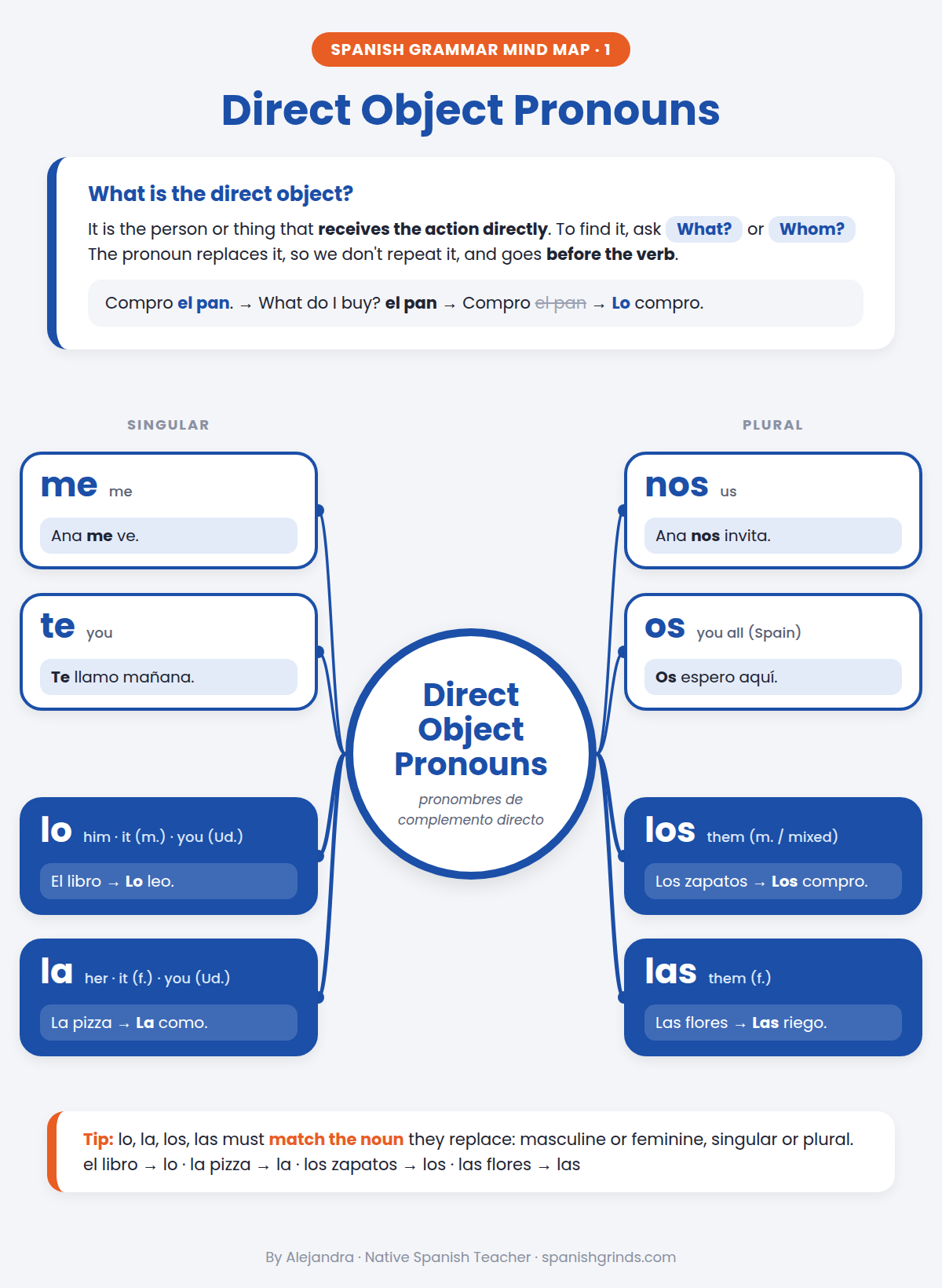
Direct Object Pronouns
A direct object is the person or thing that directly receives the action of the verb. It answers the question “what?” or “whom?”
I read the book. → What did I read? The book.
I saw Maria. → Whom did I see? Maria.
In Spanish, the direct object pronouns are:
| Pronoun | Meaning |
|---|---|
| me | me |
| te | you (informal) |
| lo | him / it (masculine) |
| la | her / it (feminine) |
| nos | us |
| os | you all (Spain, informal) |
| los | them (masculine) |
| las | them (feminine) |
Examples:
Leo el libro. → Lo leo. (I read it.)
Veo a María. → La veo. (I see her.)
Compramos las entradas. → Las compramos. (We buy them.)
Notice that the pronoun matches the gender and number of the noun it replaces — that’s the part learners usually pick up quickly. The trickier part comes next, with indirect object pronouns.
Indirect Object Pronouns
An indirect object is the person who receives the direct object, or who is affected by the action — usually the answer to “to whom?” or “for whom?”
I wrote a letter to my sister. → To whom did I write? To my sister.
She gave a gift to the children. → To whom did she give it? To the children.
In Spanish, the indirect object pronouns are:
| Pronoun | Meaning |
|---|---|
| me | to/for me |
| te | to/for you (informal) |
| le | to/for him, her, it |
| nos | to/for us |
| os | to/for you all (Spain, informal) |
| les | to/for them |
Examples:
Escribo una carta a mi hermana. → Le escribo una carta. (I write her a letter.)
Dimos un regalo a los niños. → Les dimos un regalo. (We gave them a gift.)
Notice something important here: unlike direct object pronouns, le and les don’t change for gender — they work the same whether you’re talking about “him,” “her,” or “it.” This is actually one of the biggest sources of confusion for learners, because in the direct object table, lo/la clearly split by gender — but le/les don’t. We’ll dig deeper into exactly this problem in the next post of this series.
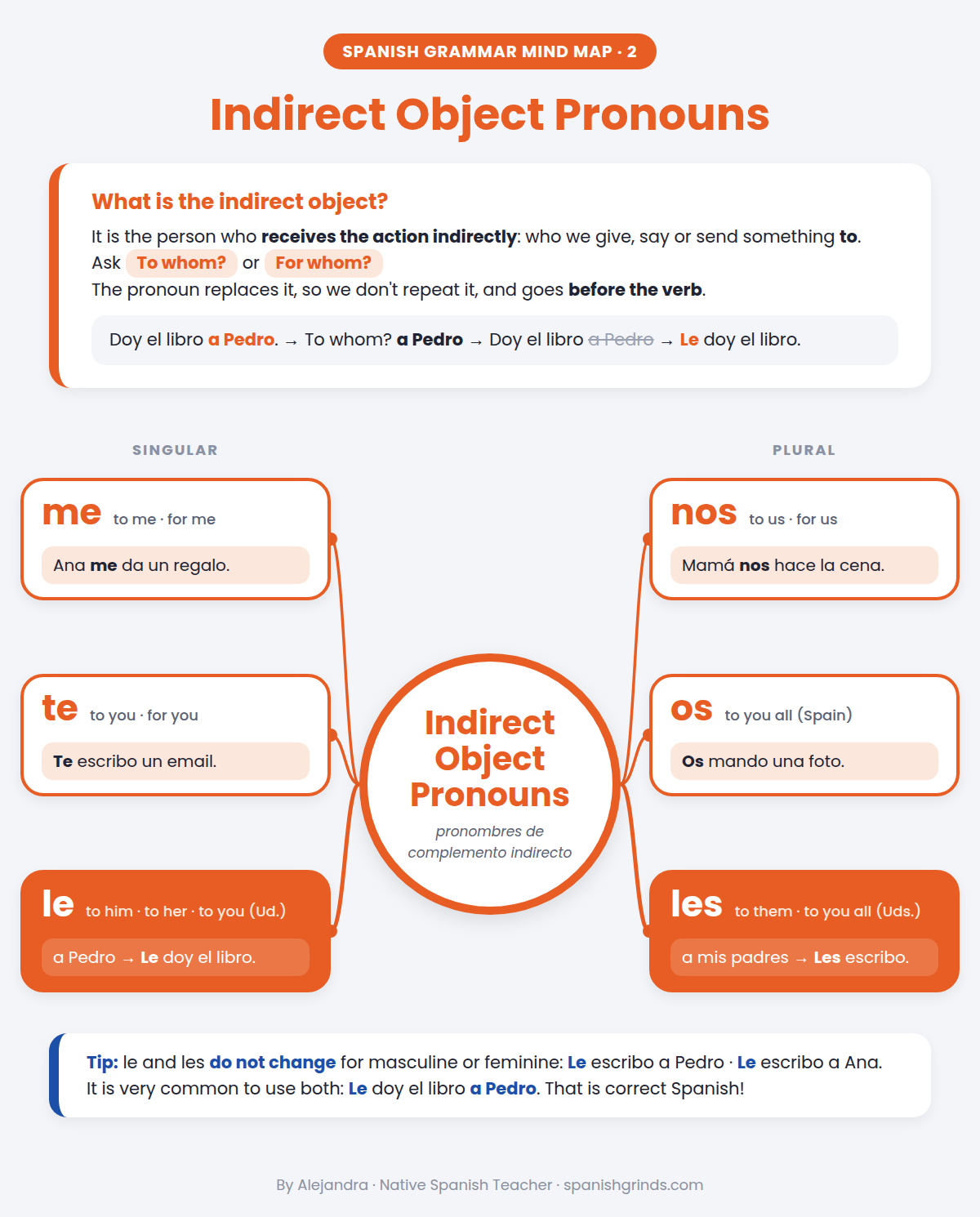
Alt text: Mind map of Spanish indirect object pronouns: me, te, le, nos, os, les, with meanings and examples
Direct vs. Indirect — How to Tell Them Apart
The easiest way to know which type of pronoun you need is to ask yourself a simple question about the verb:
- “What?” or “whom?” → you need a direct object pronoun
- “To whom?” or “for whom?” → you need an indirect object pronoun
Let’s test it with a tricky example:
Le escribo una carta a mi madre.
Ask yourself: What do I write? A letter → that’s the direct object (una carta).
To whom do I write? To my mother → that’s the indirect object (a mi madre → le).
So in this sentence, there are actually two objects at once — a direct one (una carta) and an indirect one (a mi madre) — but only the indirect one has been replaced by a pronoun (le) here. If we replaced both, we’d get se la escribo — which we’ll cover later in this series.
A quick trick many learners find helpful: if the sentence involves giving, telling, writing, or saying something to someone, there’s a strong chance you need an indirect object pronoun for that person.
Here’s everything side by side. Notice that me, te, nos, os are the same in both lists — only the third person changes:
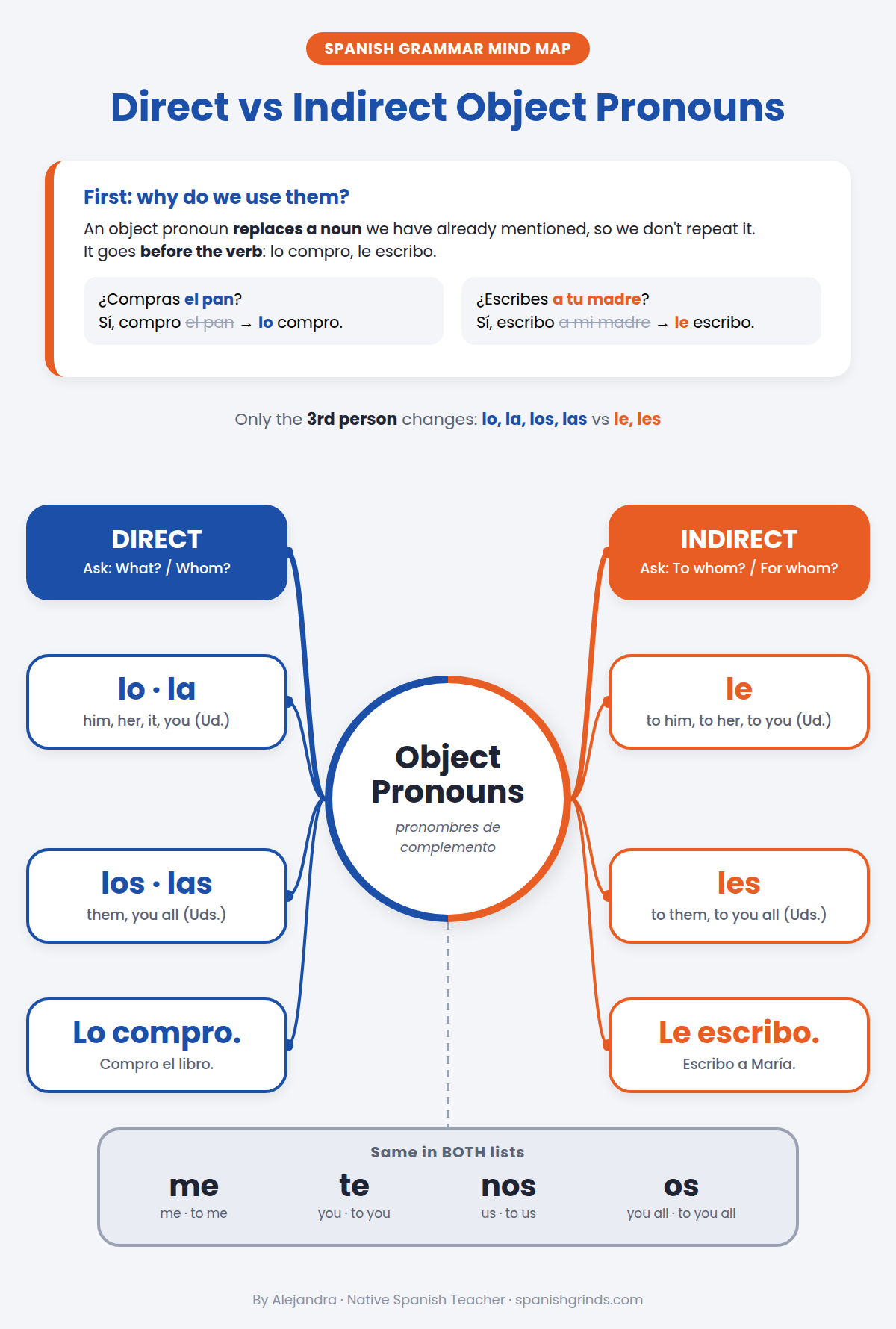
Alt text: Summary mind map comparing Spanish direct object pronouns (lo, la, los, las) and indirect object pronouns (le, les)
Where Does the Pronoun Go in the Sentence?
Object pronouns in Spanish don’t go where you might expect if you’re used to English word order. There are two main rules:
- Before a conjugated verb
Lo veo. (I see it.)
Le escribo. (I write to him/her.)
No la conozco. (I don’t know her.)
- Attached to the end of an infinitive or a gerund
Quiero verlo. (I want to see it.) — or Lo quiero ver.
Estoy escribiéndole. (I am writing to him/her.) — or Le estoy escribiendo.
Notice that in these second examples, there are actually two correct positions — either attached to the infinitive/gerund, or moved before the main verb. Both are used in everyday Spanish, so it’s worth getting comfortable with both versions.
One more rule to remember: with commands, the pronoun attaches to the end of positive commands, but goes before negative commands.
¡Escríbele! (Write to him!) — positive command, attached
¡No le escribas! (Don’t write to him!) — negative command, before the verb
Quick Practice
Let’s put it all together with a few quick examples. Try to identify whether each pronoun is direct or indirect before checking the explanation.
- Compré las flores. Las compré en el mercado.
→ Las is a direct object pronoun — it replaces las flores (what I bought).
- Mi abuela me regaló un libro.
→ Me is an indirect object pronoun — it answers “to whom did she give the gift?” (to me).
- ¿Viste a Pedro? Sí, lo vi ayer.
→ Lo is a direct object pronoun — it replaces a Pedro (whom I saw).
Want more practice? Our companion PDF workbook has extra gap-fill and sentence-transformation exercises with a full answer key, so you can check your progress on your own.
Now that you’ve got the basics of direct and indirect object pronouns, it’s time to tackle the point that trips up almost every Spanish learner: knowing when to use lo/la versus le. In the next post of this series, we’ll break down exactly why this happens — and how to stop making the mistake for good.