
Let me start by telling you something that might surprise you.
The explanation you were probably given — “use ser for permanent things and estar for temporary things” — is not wrong exactly. But it is incomplete. And that incompleteness is what causes confusion, because you will find sentences that completely break that rule within the first five minutes of using it.
Why is it “está muerto” (he is dead) when death is permanent?
Why is it “la fiesta es en mi casa” (the party is at my house) when a party is temporary?
I have been teaching Spanish for years. I am a native Spanish speaker. And I want to give you the explanation I actually give my students — not the one from the textbook.
THE ONE QUESTION THAT CHANGES EVERYTHING
Before you choose between ser and estar, ask yourself this:
Am I describing WHAT this thing IS — or HOW it is right now?
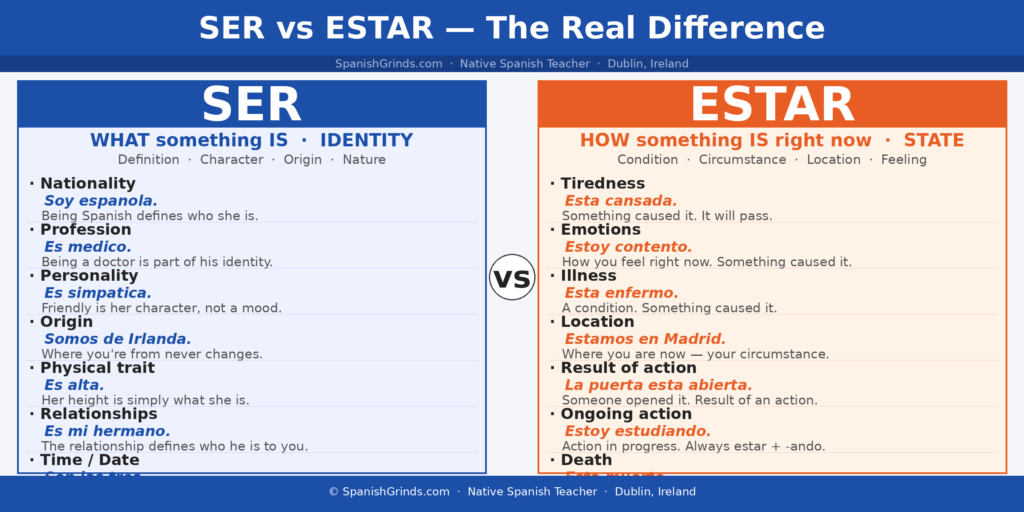
WHAT it IS → SER
HOW it is right now → ESTAR
That’s it. That is the real framework.
Ser is about identity and definition. It answers the question “what is this?” or “who is this person?”
Estar is about state and condition. It answers the question “how is this right now?” or “where is it?”
Everything else follows from this.
THE “CAUSED BY SOMETHING” TEST
Here is another way to think about it — and this one is particularly useful for adjectives.
Ask yourself: was this condition caused by something? Did something happen to bring this about?
Think about “está cansada” (she is tired). She didn’t come into the world tired. Something happened — she worked all day, she didn’t sleep, she ran a marathon. Her body is in a condition right now as a result of that. That’s a state → estar.
Now think about “es alta” (she is tall). Nothing caused her height in this moment. It’s simply what she is. It defines her physically. That’s identity → ser.
This “caused by something” test works especially well with emotions, physical states, and conditions — all of which use estar.
WHAT COMES AFTER THE VERB IS A CLUE
Here is something practical that I teach my students. Look at what comes after the verb — it gives you a strong clue.
If the next word is a NOUN — it’s almost always ser. Because you are defining or identifying what something is.
“Es médico.” (He is a doctor.) — noun after the verb → ser.
“Es mi hermano.” (He is my brother.) — noun → ser.
“Es un perro.” (It is a dog.) — noun → ser.
If the next word is an ADJECTIVE — you need to think more carefully. Both ser and estar are possible with adjectives, but the meaning changes completely. More on this below.
THE TWO MISTAKES I SEE EVERY SINGLE WEEK
After years of teaching English speakers, these are the two mistakes that come up in almost every lesson. I am sharing them because understanding why your brain makes them is the fastest way to stop making them.
MISTAKE 1 — Using ser for a state
✗ Es cansada.
✓ Está cansada.
English only has one verb for “to be” — so your brain reaches for whatever feels familiar. But tiredness is not her identity. It’s a condition her body is in right now. Something caused it. It will pass. In Spanish, that makes it a state — and states use estar.
MISTAKE 2 — Using estar for a definition
✗ Está un perro. / Está mi madre.
✓ Es un perro. / Es mi madre.
When you are identifying what something is — what category it belongs to, who someone is — you are not describing a state. You are defining. “Un perro” is what the animal IS. “Mi madre” is who she IS. Definitions use ser.
These two mistakes go in opposite directions, which is actually useful. Together they show you exactly where the line is.
WHY “PERMANENT VS TEMPORARY” LETS YOU DOWN
The permanent/temporary rule fails because Spanish speakers don’t actually think about permanence when they choose. They think about identity versus state.
“Está muerto” uses estar — not because death is temporary (it isn’t), but because death is a STATE the body is in. Something happened. The body is in that condition.
“La fiesta es en mi casa” uses ser — not because the party is permanent (it isn’t), but because the location is part of defining what the event IS. It’s describing the event itself.
Once you stop thinking about time and start thinking about identity versus state, the exceptions stop being exceptions.
THE TRICKY PAIRS — WHEN THE MEANING CHANGES COMPLETELY
Some adjectives work with both ser and estar — but the meaning changes entirely depending on which you use. These are the ones that catch even intermediate students.
Aburrido
Es aburrido → He is a boring person.
Está aburrido → He is bored right now.
Listo
Es listo → He is clever.
Está listo → He is ready.
Malo
Es malo → He is a bad person.
Está malo → He is ill.
Bueno
Es bueno → He is a good person.
Está bueno → It tastes good.
Rico
Es rico → He is wealthy.
Está rico → It is delicious.
Seguro
Es seguro → It is safe.
Está seguro → He is certain/sure.
Nervioso
Es nervioso → He is a nervous person.
Está nervioso → He is nervous right now.
Vivo
Es vivo → He is sharp/clever.
Está vivo → He is alive.
Notice the pattern in each pair. Ser describes the person’s character or nature — what they are like as a person. Estar describes how they are in this moment — a feeling, a condition, a state.
A NOTE FROM A NATIVE SPEAKER
One thing I always say to my students: stop trying to apply the rule while you are speaking. By the time you have asked yourself “is this permanent or temporary?”, the moment has passed and the conversation has moved on.
Instead, train yourself to feel the difference through exposure. The more examples you see — with the reasoning explained — the more your brain starts to recognise the pattern automatically. Just like a native speaker does.
That is exactly why I created the Ser vs Estar Complete Example Guide — 200 real examples, grouped by category, each one with a short explanation of why. Not rules to memorise. Examples to absorb.
QUICK PRACTICE
Try these ten sentences. For each one, choose ser or estar — and ask yourself why.
1. Juan ___ médico.
2. Estoy ___ muy cansado hoy.
3. La sopa ___ fría.
4. Ella ___ de Argentina.
5. El museo ___ cerrado los lunes.
6. Mi perro ___ muy inteligente.
7. ¿Dónde ___ tus llaves?
8. Hoy ___ jueves.
9. Mi abuela ___ enferma esta semana.
10. Este restaurante ___ muy bueno.
Answers: 1. es 2. estoy 3. está 4. es 5. está 6. es 7. están 8. es 9. está 10. es
—
About the author: Alejandra is a native Spanish teacher based in Dublin, Ireland. She teaches one-to-one online Spanish lessons via Zoom, specialising in Leaving Certificate Spanish and general Spanish for all levels.
👉 Book a free trial lesson at spanishgrinds.com